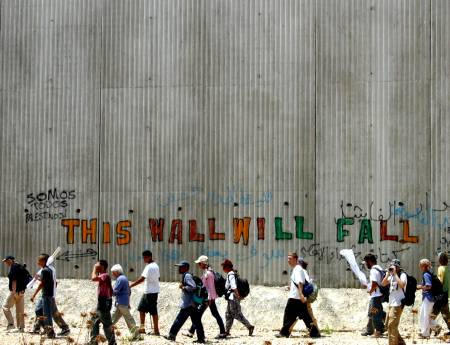
Monday, January 3, 2011

Breaking the Israel-Palestine Deadlock

by: Noam Chomsky, Op-Ed


While intensively engaged in illegal settlement expansion, the government of Israel is also seeking to deal with two problems: a global campaign of what it perceives as “delegitimation” – that is, objections to its crimes and withdrawal of participation in them – and a parallel campaign of legitimation of Palestine.

The “delegitimation,” which is progressing rapidly, was carried forward in December by a Human Rights Watch call on the U.S. “to suspend financing to Israel in an amount equivalent to the costs of Israel’s spending in support of settlements,” and to monitor contributions to Israel from tax-exempt U.S. organizations that violate international law, “including prohibitions against discrimination” – which would cast a wide net. Amnesty International had already called for an arms embargo on Israel. The legitimation process also took a long step forward in December, when Argentina, Bolivia and Brazil recognized the State of Palestine (Gaza and the West Bank), bringing the number of supporting nations to more than 100.

International lawyer John Whitbeck estimates that 80-90 percent of the world’s population live in states that recognize Palestine, while 10-20 percent recognize the Republic of Kosovo. The U.S. recognizes Kosovo but not Palestine. Accordingly, as Whitbeck writes in Counterpunch, media “act as though Kosovo’s independence were an accomplished fact while Palestine’s independence is only an aspiration which can never be realized without Israeli-American consent,” reflecting the normal workings of power in the international arena.

Given the scale of Israeli settlement of the West Bank, it has been argued for more a decade that the international consensus on a two-state settlement is dead, or mistaken (though evidently most of the world does not agree). Therefore those concerned with Palestinian rights should call for Israeli takeover of the entire West Bank, followed by an anti-apartheid struggle of the South African variety that would lead to full citizenship for the Arab population there.

The argument assumes that Israel would agree to the takeover. It is far more likely that Israel will instead continue the programs leading to annexation of the parts of the West Bank that it is developing, roughly half the area, and take no responsibility for the rest, thus defending itself from the “demographic problem” – too many non-Jews in a Jewish state – and meanwhile severing besieged Gaza from the rest of Palestine.

One analogy between Israel and South Africa merits attention. Once apartheid was implemented, South African nationalists recognized they were becoming international pariahs because of it. In 1958, however, the foreign minister informed the U.S. ambassador that U.N. condemnations and other protests were of little concern as long as South Africa was supported by the global hegemon – the United States. By the 1970s, the U.N. declared an arms embargo, soon followed by boycott campaigns and divestment. South Africa reacted in ways calculated to enrage international opinion. In a gesture of contempt for the U.N. and President Jimmy Carter – who failed to react so as not to disrupt worthless negotiations – South Africa launched a murderous raid on the Cassinga refugee camp in Angola just as the Carter-led “contact group” was to present a settlement for Namibia. The similarity to Israel’s behavior today is striking – for example, the attack on Gaza in January 2009 and on the Gaza freedom flotilla in May 2010.

Tears and gas: a call to mobilise

Getting nowhere at home, Israel's Palestine solidarity activists push a global call for action.


As 2010 came to a close in the West Bank under the regular, weekly cloud of teargas experienced among the villages bordering Israel's 1967 Green Line, 2011 started with the death of Palestinian woman from the village of Bi'lin and the arrest of 19 Israeli activists in the Tel Aviv area.
The new year is just days underway and already it is clear that this will be the year that building ethno-nationalist rhetoric and legislation turned into concrete action.
Since the election of the right-wing Netanyahu government, the weekly West Bank demonstrations in the town of Bi'lin have faced greater military repression, while the small but persistent radical Israeli left has moved from isolated protest to bringing the West Bank joint resistance model into Israel.
Following the killing of Bi'lin's first resident - Bassem abu Rahmah in 2009 - the continued jailing of village popular committee leader Abdullah Abu Rahmah, and a series of night time arrest raids without a murmur of protest from greater Israeli society, marginalised Israeli activists are now appealing outside their boarders and pushing forward the international boycott movement.

Tears and gas
After the announcement of the death of Jawaher abu Rahmah on the morning of January 1 from the complications of massive teargas exposure during the previous day's demonstration, hundreds of Israeli leftists descended on the the ministry of defence, blockading the main road in front of it.

A short anthology of racism in Israel

December 29, 2010 was a record day for Israeli racism; and we're just getting started.

By Niva Lanir


Last Wednesday, December 29, a hullabaloo broke out at the entrance to the Yad Vashem Holocaust and Martyrs memorial museum in Jerusalem. A group of Palestinian women (from Hebron, Nablus and Bethlehem ), members of the forum of Israeli and Palestinian Bereaved Families, had come to visit the museum. This was their first visit to Israel, the culmination of their discussion on "Understand the Narrative" with their Israeli counterparts. As they waited for the Israeli group outside the museum, they encountered several sharp-eyed Israeli high-school students. "Get out of here, you sluts," the students shouted at them. "This place is ours, and there is no room for Arabs." Officials at Yad Vashem and the Israeli members of the forum expressed their regret and repugnance over the incident and apologized. But it is unlikely that the tour of the museum undid the damage.

From which school was this class? Sources at Yad Vashem say they still do not know. That morning, 32 classes visited the museum and it is difficult for them to figure out exactly which one was involved in the incident, although they would be grateful for any help. FYI, Mister Education Minister.
But even barring this event, the morning of December 29 reads like an anthology (small? partial? ) of racism: the rabbis wives' letter promoting racial purity - "Don't go out with Gentiles"; the call for targeted assassinations by National Union MK Yaakov Katz - "Snipers should lie in wait and shoot bullets at the heads of those Bedouin who bring in caravans of infiltrators"; the Breathalyzer of MK Otniel Schneller - "Before the Russian immigration, there was no problem of drunken driving"; and the anti-syllabus reconnaissance unit of Im Tirtzu that is once again threatening Ben-Gurion University, this time with a petition to the High Court of Justice.

Sunday, January 2, 2011

Pro-Israel American Pundits Reconsidering Positions

By Max Fisher
 
Over the past year, some of Israel's staunchest supporters among the U.S. commentariat have become more and more critical of the country and its role in the struggling Israel-Palestine peace process. Israel's continuing occupation of and settlement growth in Palestinian territories have especially concerned otherwise pro-Israel pundits. Here's their latest criticism--much of it from writers who, in the past, had been far more supportive of Israeli policies--and the pushback from the U.S. writers still holding strong for Israel's practices.
  • 'What If Israel Ceases To Be a Democracy?'  The Atlantic's Jeffrey Goldberg asks because, as the expansion into Palestinian territories continues, "Jewish Israelis" may "choose to give up democracy in order to maintain Israel's Jewish voting majority." The Israeli government's "addiction to West Bank settlements, and the expansion of settlements bodes ill for the creation of a Palestinian state--and the absence of Palestinian statehood means that Israel will one day soon confront this crucial question concerning its democratic nature: Will it grant West Bank Arabs the right to vote, or will it deny them the vote? If it grants them the vote, this will be the end of Israel as a Jewish state; if it denies them the vote in perpetuity, it will cease to be a democratic state."
Oil is to Saudi Arabia what unconditional American aid and affection are to Israel--and what unconditional Arab and European aid and affection are to the Palestinians: a hallucinogenic drug that enables them each to think they can defy the laws of history, geography and demography. It is long past time that we stop being their crack dealers. At a time of nearly 10 percent unemployment in America, we have the Israelis and the Palestinians sitting over there with their arms folded, waiting for more U.S. assurances or money to persuade them to do what is manifestly in their own interest: negotiate a two-state deal. Shame on them, and shame us."
  • U.S. Jews 'Can't Take It Anymore'  New Yorker editor-in-chief David Remnick told Israeli publication Yediot (as translated from Hebrew by Didi Remez), "A new generation of Jews is growing up in the US. Their relationship with Israel is becoming less patient and more problematic." He addresses the country as a whole: "How long can you expect that they’ll love unconditionally the place called Israel? You’ve got a problem. You have the status of an occupier since 1967. It’s been happening for so long that even people like me, who understand that not only one side is responsible for the conflict and that the Palestinians missed an historic opportunity for peace in 2000, can’t take it anymore." New Jersey Jewish News editor-in-chief Andrew Silow-Carroll calls Remnick "as good a friend on the Left as Israel is likely to get--and lose."

Why the Middle East is about to split the Coalition wide open

People walk past the Dome of the Rock in Jerusalem's old city (Photo: AFP)


  By Peter Oborne

All British governments, whether of the Right or the Left, have taken a positive view of Israel, and for all kinds of understandable and commendable reasons. There is the historical fact that Britain signed the 1917 Balfour Declaration and was the imperial power that handled the so-called Palestinian mandate after the First World War. Britain therefore played a greater role in the formation of the Israeli state than anyone else.

That responsibility lives with us today, and so does knowledge of the Holocaust, the most terrible, troubling and shocking expression of collective evil in European history. No wonder that ordinary Britons have long felt a strong fellow feeling for what they see as a plucky, independent country fighting a mortal battle for life against hostile neighbours.

In recent decades, a further factor has come into play. Successive prime ministers have resolved never to challenge the foreign policy of the United States, while the US in turn has forged an unshakeable alliance with Israel. This has made Britain, by proxy, Israel’s second closest ally.

Events in recent years, however, have made this state of affairs (which once seemed so natural) anachronistic and embarrassing. It is not just the deplorable events in Gaza, where Hamas’s leaders yesterday staged a mock attack to commemorate the second anniversary of Israel’s offensive. The fulcrum moment came just over four years ago, with the Israeli invasion of Lebanon.

Certainly, Israel was provoked by Hizbollah’s cross-border attacks, but the response was unbalanced. Approximately 1,200 Lebanese were killed, including many women and children. One friend of mine, a very brave soldier who served in the British Army for 25 years, witnessed some of the Israeli attacks. He later told me that he had never experienced anything like the lack of concern for innocent human life displayed by the Israel troops, so much so that he now refuses to enter the country. Yet Britain, following the lead of the United States, refused to call for a ceasefire, let alone condemn Israel’s actions.

Restricting Israel's Arab minority


Legitimacy of Israeli democracy threatened as racism increases under discriminatory laws against Palestinian minority.

By


A number of recent incidents discriminating against Israel’s Palestinian minority has prompted Israeli Knesset (parliament) members to debate whether Israel is becoming increasingly racist.

Ronit Sela from the Association for Civil Rights in Israel (Acri) has no doubts. "Israel’s democracy is under threat as an increasingly large racist element raises its collective head. A number of racist occurrences have taken place in a climate conducive to racism. This wouldn’t have happened prior to the current right-wing Israeli government," Sela said.

Recently an organisation called Jews for a Jewish Bat Yam (a suburb near Tel Aviv) held a protest against "assimilation of young Jewish women with Arabs living in the city or in nearby Jaffa."
"It's a local organisation of Bat Yam residents, because the public is tired of so many Arabs going out with Jewish girls," explained one of the organisers, Bentzi Gufstein. "In addition to the protest, we will hand out pamphlets explaining the situation."

For all the fear of "being swamped by the Arabs", the amount of social, political and public interaction between Israel’s Jewish majority and its Palestinian minority remains restricted.
Prof. Shlomo Hasson from the Hebrew University in Jerusalem argues that relations between the two communities are largely influenced by social and economic interaction.

Defining moment for Obama

US can defend Israel in Security Council and lose credibility or revive peace process by doing the right thing.

By Adel Safty,

The Obama administration's commitment to a negotiated settlement of the Palestinian conflict, arguably unique in the history of American conflict mediation in the region, is rapidly heading towards a fate common to all previous American peace plans for the region: failure.

Direct American involvement as an intermediary in the Arab-Israeli conflict goes back to the 1950s. But it was not until 1969 that the first US peace plan was formulated and presented to the parties. Then US secretary of state William Rogers presented a peace plan designed to facilitate the implementation of UN

Security Council resolution 242 through negotiations between Israel, Egypt and Jordan.
Then Egyptian president Jamal Abdul Nasser surprised the Israelis by accepting the Rogers plan; Israel still rejected it. The Rogers plan was eventually torpedoed by Henry Kissinger, then national security adviser in the Nixon White House and Rogers' arch-rival.

Nevertheless, the Rogers peace plan set a precedent for all subsequent American peace plans to resolve the Palestinian conflict. They all came to follow the same format: They are usually presented to the parties following a war or the eruption of violent confrontations.

The Rogers plan followed the 1967 war and the 1969 war of attrition. This had the advantage of heightened interest on the part of the protagonists — anxious to avoid the violent intensification of the conflict. But this feature also had some drawbacks, including hasty improvisation and absence of well-thought out sanctions the need for which was subordinated to the urgency of conflict management.

American peace plans usually promote negotiations between the parties. This is laudable except that the negotiations promoted by American initiatives are not framed by the principles of international law and legitimacy, but rather founded on the prevailing balance of power that favours Israel — the occupier and the dominant military power in the region. In fact, all American peace plans contain guarantees for Israel's security and provide advanced military hardware to ensure its uncontested military superiority.

The price of resisting

 Jody McIntyre By Jody McIntyre

On New Year’s Eve, as people across the world celebrated together, Jawaher Abu Rahmah lay alone, struggling for breath in a Ramallah hospital. The day before, the people of her village, Bil’in, in the West Bank, had marched to Israel’s wall, which cuts through half of the village, to non-violently demonstrate against the theft of their land, just as they have done every Friday since construction on the wall began in 2005.

Jawaher had suffered from asphyxiation as a result of the tear gas the Israeli army had fired at demonstrators.  Jawaher, however, was not participating in the demonstration herself; she was sitting at her family’s home 500 metres away when she begun to suffocate. On Saturday morning, Jawaher, aged 35, died in hospital.

In 2009, I spent six months living in Bil’in; for four months straight, the Israeli army would raid the village at night, taking young teenage boys from their homes, some as young as thirteen years old, and imprisoning them for months on end.  No reasons were given for their arrests, but those attending the demonstrations were often targeted.

Tension flares amid Israeli raids

One Palestinian shot dead at checkpoint in the West Bank and two more injured in Gaza as Israeli jets hit refugee camp.


Two civilians have been injured in air raids on Gaza by Israeli forces, according to Palestinian emergency services officials, while the Israeli military says a projectile has been fired on Israel.
A military spokesman said it was launched from the Gaza Strip into the southern Eshkol region on Sunday. No casualties or damage were reported.


The Israeli army confirmed the air raids by its fighter jets, saying that they were carried out in response to Palestinian rocket attacks on Israeli territory on Saturday.
T
wo people were wounded in one raid, which targeted the Nuseirat refugee camp in central Gaza. The other attack, on the Jabaliya refugee camp in the north of Gaza, did not result in any casualities.

An Israeli spokesman said one of the raids targeted a Hamas centre, while the other was aimed at an arms workshop. Hamas has governed Gaza since winning a power struggle with Fatah in 2006.
Tensions have been rising in Gaza in recent weeks, with Palestinian fighters in the territory firing a series of rockets at Israel, which has retaliated with air raids.

West Bank death
In yet another incident on Sunday, Israeli troops shot and killed a Palestinian man who approached a checkpoint in the occupied West Bank holding a bottle, according to Israeli and Palestinian officials.
An Israeli military spokesperson said the man who was killed at the checkpoint did not heed orders to halt, and he was fired upon as he continued to approach Israeli soldiers.

The man, who was in his early twenties, was shot in the chest and leg, according to a Palestinian medical worker who collected the body from the Israeli military checkpost near the city of Nablus.

The military spokesperson said she did not know what the contents of the glass bottle were, but that the "soldiers apparently felt threatened".

Nabil Abu Rudeina, spokesman for Mahmoud Abbas, the Palestinian president, condemned the shooting, terming it a "dangerous escalation".

Saturday, January 1, 2011

Any Respect for International Law Left in The US Congress?

by Franklin Lamb, 
Beirut


This week marks the second anniversary of among the most savage criminal slaughters of human life in long memory. The 522 hour indiscriminate carnage, “Cast Lead”  that killed 1,417 Palestinians, mostly civilians, 352 of them children, injuring for life more than 5,300 , indicts  Israel as well as those countries that continue to supply it weapons, diplomatic cover and to enforce Israel’s  illegal siege on sealed Gaza.

The US administration, as revealed in a State Department cable posted by Wikileaks, has been working overtime with Israel to parry further condemnation of  Israeli crimes documented in the Richard Goldstone and Richard Falk Reports, among others. These investigations established massive violations of human rights and international law, war crimes, and possible crimes against humanity while refuting claims by Israel that it acted according to the limited international right of self-defense. Goldstone, Falk and others have demonstrated that it was both the victims of Cast Lead and the Mavi Marmara who alone possessed the right of self-defense in light of Israel’s agressions, not Israel.
As Professor Falk instructs us, Israeli actions in both cases:

“Are certainly  acts of aggression under the UN Charter, and an act of war by reference to customary international law. Whenever force is used in situations other than in situation where a proper claim of self-defense is made, the undertaking is unlawful, and if as here, it is an instance of flagrant non-defensive force, the attacker is engaged in criminal conduct and both the offending state and the perpetrators acting on behalf of the should be held responsible, and to the extent international crimes took place, held accountable.”.

Rather than hold Israel to the “single universal human rights standard that applies to every country”, as Hilary Clinton crowed on Human Rights Day during an appearance before the Brookings Institute, the Obama administration claims others have ‘rushed to judgment’ and it has refused to condemn Israel’s  May 31, 2010 murder of an American citizen on the Mavi Marmara humanitarian aid boat, 19 year old Furkan Dogan.

Rushing to judgment and ignoring International law in Congress
Maybe it requires the moral clarity of 19 year old Layal, and her teen aged friends huddled in a damp, candle lighted, cold subterranean hovel in Shatila Palestinian Refugees camp this New Years in Beirut, to speak the naked truth.  In their make shift ‘classroom’ the teenagers tutor  camp kids  on the three R’s  after  the youngsters double shift ‘short day’ and too early daily dismissal  at  Shatila’s overcrowded and undersupplied and understaffed, UNRWA Ramallah and Hemeh schools.

Shock and awe

The surprise missile attack on a Gaza police station that launched the Cast Lead operation set off waves of international condemnation and a concerted Israeli effort to justify the strike. Now, two years later, Gaza eyewitnesses and IDF sources reopen old wounds.


By Shay Fogelman

 
Many Gaza residents who were interviewed for this report recall Saturday morning, December 27, 2008, as being sunny and tranquil, with clear skies. The lack of clouds was unusual, following a week of stormy weather, when winds ripped tiles off decrepit rooftops in refugee camps and rains left large mud puddles throughout the Strip. Many felt there would be a lull in the fighting that had begun several weeks earlier. But this hope was shattered at 11:30 in the morning, when missiles and bombs began shrieking through the air.
Today, two years later, it seems that understanding the opening act of the Cast Lead operation is key to grasping the operation as a whole, and to a certain extent, the actions of the IDF since that campaign. It began with five missiles fired from the air into a group of policemen undergoing inspection at a station in "Arafat City," a huge government complex located in the center of Gaza City. Videos filmed at the site a few minutes after the attack, some of them by means of cellular telephones, show extraordinary images. First come ambulances and other aid vehicles, racing to the compound where the inspection was held. Subsequently, vehicles pass lightly wounded men who managed to get up and walk away from the carnage. Sirens wail, as the vehicles pass eucalyptus trees and head to the blood-soaked inspection area. Members of the medical rescue teams appear to be helpless and in shock, as they run about and try to tend to the wounded, chanting verses from the Koran, and angry imprecations at heaven. Most of the policemen were already dead.

The medics let the mortally wounded die; it was more important to try to save the hundreds of less critically wounded people at dozens of sites that had been attacked around the city. The videos then show policemen and civilians putting the wounded and dead into private vehicles; doors that had been blasted off adjoining structures were turned into makeshift stretchers. Vehicles speeding toward the compound ran over body parts.


Sister of Bilin victim dies in anti-fence protest

Palestinians report Jawaher Abu Rahma, 36, who suffered tear gas inhalation during anti-fence protest, died in Ramallah hospital. Her brother Bassam was killed in Bilin two years ago after being hit with gas grenade. IDF: Soldiers used tear gas in routine manner


Jawaher Abu-Rahma, who was hurt Friday after inhaling tear gas during a protest in Bilin, died of her wounds on Saturday. Palestinian sources reported that the 36-year-old woman inhaled large quantities of tear gas and died in a Ramallah hospital. 


According to doctors, Abu Rahma was admitted suffering from blood poisoning and did not respond to treatment. After a long night the doctors were forced to pronounce her dead Saturday morning.

Jawaher is the sister of Bassam Abu Rahma who was killed two years ago during a protest in the same village. Their brother Ahsraf was once shot by an IDF soldier in a rally in Naalin.

The IDF said that soldiers used tear gas to disperse Friday's protest in a routine manner. The army added that an initial examination raises doubts regarding Abu Rahma's cause of death and that an investigation is being held. 

The IDF initially claimed that Abu Rahma had died in her home but Dr. Muhammad Eida, director of the Palestine Medical Complex said that she did not leave the hospital until her death was pronounced. "Jawaher arrived unconscious and unable to breath on her own yesterday at 3 pm," he said. "We sent her to the intensive care unit. She apparently inhaled large quantities of tear gas which penetrated her blood and caused blood poisoning."

The doctor said that Abu Rahma did not respond to the medical treatment and that her death was pronounced at 9 am.
 
The official Palestinian news agency also reported that Abu Rahma had died. Three other individuals were injured during the protest, which was attended by some 1,000 demonstrators. According to the Palestinians, dozens more were lightly injured after inhaling tear gas.

Bil'in protester dies after exposure to tear gas shot by IDF


Hundreds of Palestinians and anti-barrier activists have attended the funeral procession of a Palestinian protester who died after inhaling the gas fired by Israeli forces quelling a protest in the occupied West Bank.
Mourners at the funeral on Saturday blamed the Israeli military for the protester's death.
"What happened yesterday, there were too many forces from the occupation, guarding the apartheid wall, and they started shooting, so many, so many gas (canisters) mixed with smelly water. And this large amount of gas caused many protesters a fealing of suffocation, and it killed Jawaher
Abu Rahme. And immediately we moved her to the Palestinian medical centre," said family member Rateb Abu Rahme.

"This death was caused by their brutality, by the fact that they are using tear gas that was banned in Europe in the 60s and 70s, because it is lethal. But here, on Palestinians, they continue using it," said anti-barrier activist Jonathan Pollak.
Jawaher Abu Rahme's brother Bassem, in his 20s, was killed in 2009 after a tear gas canister
struck him in the chest.
Mohammad Eidi, head of emergency at Ramallah Hospital, told the Reuters news agency in a phone conversation that Abu Rahme had arrived there on Friday with very weak breathing as a result of inhaling a gas.
The doctor added that the type of gas is still not identified.
The Israeli army said on Friday troops had employed riot dispersal means against stone throwers. A military spokesman, reached by telephone on Saturday, had no immediate comment.